NEWS · FLAGSTAFF, ARIZONA
Nearby Earth-like planets are probably behind Earth in evolution, study estimates
Scientists modelled how much photosynthesis 29 nearby planets could have done in their lifetimes. Two came out ahead of Earth; most look like microbe worlds at best.
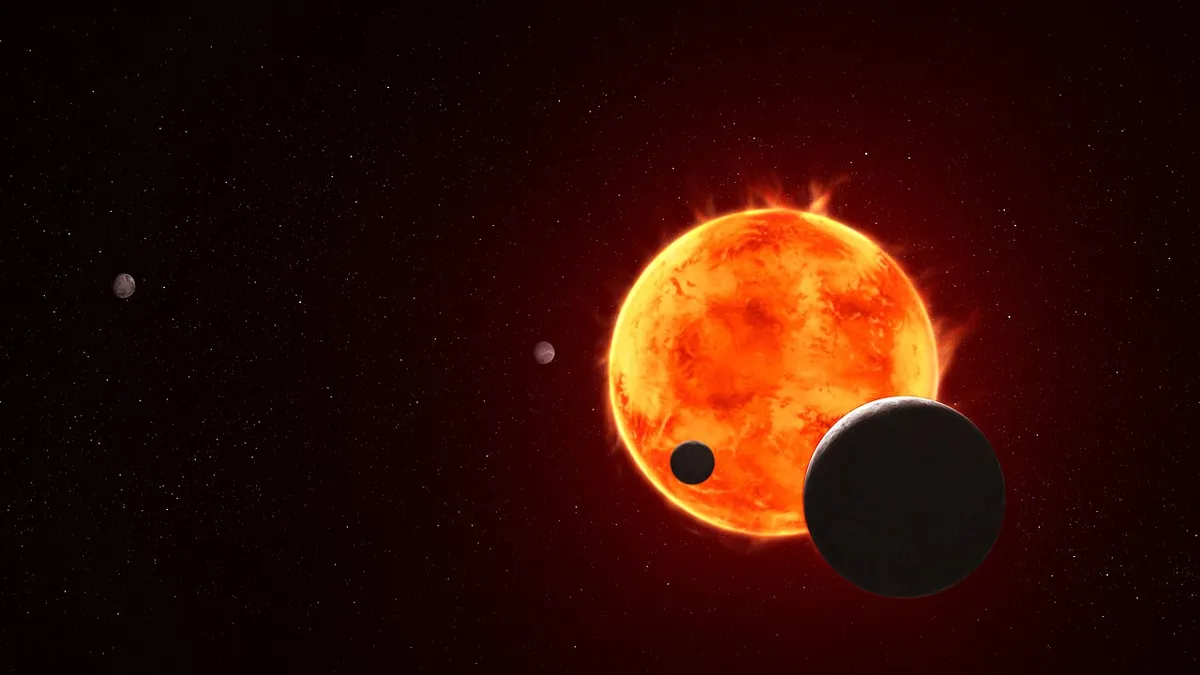
If intelligent life is common in the galaxy, physicist Enrico Fermi famously asked, “Where are they?” — a question Doughty raises in announcing the study. A team led by Chris Doughty, a professor of ecoinformatics at Northern Arizona University in Flagstaff, has tried a new way to put numbers on part of that question. Their study, published on September 22 in the International Journal of Astrobiology, estimates how far life could have evolved on 29 nearby exoplanets that might be able to support it. The science site The Debrief brought it back into the news on October 14.
The short answer, according to the authors: most of these worlds are probably behind Earth, not ahead of it. Most Earth-like planets near us, Doughty said in the university’s announcement, “are likely to be evolutionarily behind us and still at the microbial stage.”
How the estimate works
The team’s starting idea is that how far evolution has got on a planet depends less on its age than on how much energy its plants have captured over time — the total carbon fixed by photosynthesis. The paper treats this as a hypothesis and proposes it as a new method. By its estimate, Earth has fixed about 9.4 × 1025 grams of carbon so far.
They tested the idea first on TRAPPIST-1e, a rocky planet about 40 light-years away that orbits a red dwarf star. Using climate simulations by co-author Denis Sergeev, a lecturer at the University of Bristol, and treating the planet as an ocean world, they estimated it would take about 18 billion years to fix as much carbon as Earth has. The planet’s estimated age is 7.6 billion years, which puts it at a possible microbial stage, but not at the stage of complex, many-celled life.
Red dwarfs are dimmer than the Sun, and planets close to them are often tidally locked, with one side always facing the star. “The total annual photosynthesis is likely lower because there is less light and half the planetary surface area available for photosynthesis,” said co-author Michael Gowanlock, an associate professor of informatics at NAU.
Two planets that may be ahead
Applying the same method to all 29 planets, the paper identifies two whose estimated total photosynthesis is greater than Earth’s and which, it says, could have both multicellular and intelligent life: GJ 1061c and K2-3d. Under several of the study’s scenarios, both rank highest because they are bigger, hotter, brighter and older than most of the other planets. NASA’s exoplanet catalogue lists both as super-Earths, larger than our planet. The paper’s summary also places six planets at a possible multicellular stage; NAU’s announcement says three other planets could be at a stage roughly like Earth’s age of the dinosaurs. The two sources do not say how these groups overlap.
The planets that came out on top are also the ones most likely to be dominated by ecosystems limited by rainfall, such as deserts or temperate ecosystems, the authors found. Doughty said the ecological characteristics shaping any advanced life there “might be more ‘Dune’ than ‘Avatar’” — closer to the desert world of Frank Herbert’s novels than the lush jungle moon of James Cameron’s films.
What it does — and doesn’t — tell us
The researchers say their figures are estimates, not proof that life exists anywhere beyond Earth. Nobody yet knows what atmospheres these planets have, and that would strongly affect their climates and any life on them. The authors expect observations from the James Webb Space Telescope to help refine the numbers. The coverage we found quoted only the study’s own authors; we did not find comment from outside scientists.
The study does not look at UFOs or UAP reports at all. Its return to the news came in the same week that a former head of the Pentagon’s UAP task force claimed in a new memoir that the U.S. holds non-human craft. The two are very different kinds of claim: one is a published scientific estimate about distant planets, built on a stated hypothesis; the other is a personal account not backed by public evidence. Neither tells us what any particular object in the sky was — for that, see what most sightings turn out to be.
Sources
- International Journal of Astrobiology: Calculating potential cumulative carbon fixed and evolutionary stage for Earthlike planets in our solar neighborhood (Doughty et al.), September 22, 2026
- Northern Arizona University: Is a nearby advanced alien civilization out there waiting to pounce on Earth? Unlikely, says new study, September 22, 2026 archived
- The Debrief: “More Dune Than Avatar”: Scientists say these nearby exoplanets could be home to alien life, October 14, 2026 archived
- NASA Exoplanet Catalog: GJ 1061 c archived
- NASA Exoplanet Catalog: K2-3 d archived