NEWS · WASHINGTON, D.C.
The Pentagon’s eighth UFO release: the CIA’s 1952 “flying saucer” briefing and the night Lockheed’s chief engineer saw one
The Department of War published 43 more UAP records on November 20: six CIA papers from 1952, a 1953 report by the engineer behind the U-2, three new military videos and more of the AAWSAP files.
On Friday, November 20, the Department of War published the eighth release of files under PURSUE, its program for making UAP records public. In a statement from chief Pentagon spokesman Sean Parnell, the department said the files are on WAR.GOV/UFO, that it “will release additional files on a rolling basis,” and that it and its “agency partners are actively working on the next release of UAP files.” The statement gave no numbers and singled out no file. According to The Independent, as quoted by UNILAD, the Pentagon said it was not providing any comment or assessment on the files overall.
By the Pentagon’s own file list the release holds 43 records: 40 documents and three videos. That brings the archive to 521 files in eight releases since May 8. Most of the documents are old. Six are CIA papers from 1952, 17 are Air Force intelligence reports, almost all from 1957, eight are “Unresolved UAP Report” files from California between 1949 and 1966, and eight more come from the Defense Intelligence Agency’s AAWSAP program of 2008–2010. You can browse every file in Release 8.
What the CIA told itself in 1952
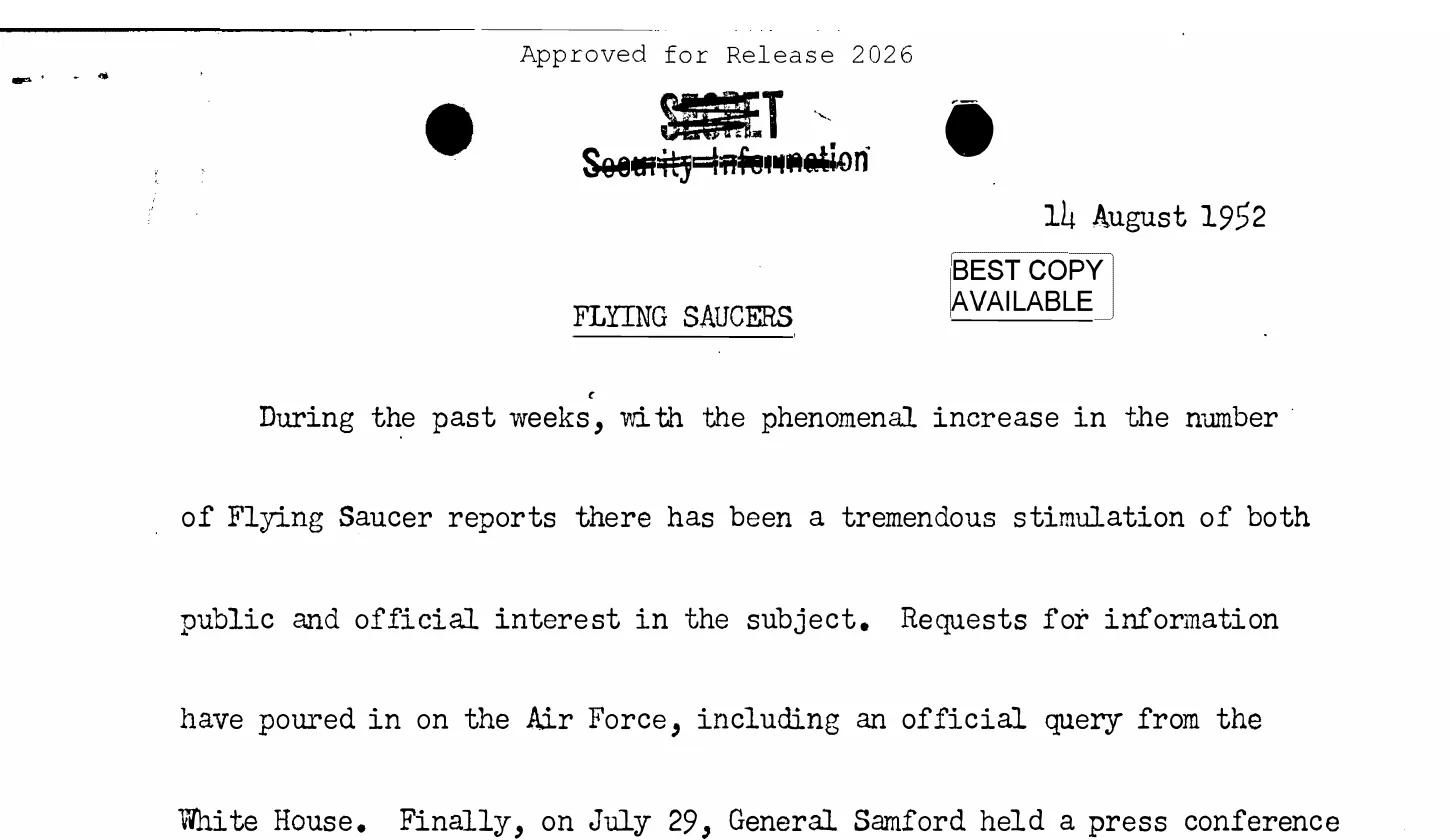
The lead file, CIA-UAP-D027, is the script of an internal briefing by the CIA’s Office of Scientific Intelligence, dated 14 August 1952. It opens with the summer’s flood of “Flying Saucer reports,” an official query from the White House, and Major General John Samford’s July 29 press conference, at which he said the Air Force analysis showed “no pattern of anything remotely consistent with any menace to the United States.” The office says it reviewed its own intelligence back to the Swedish sightings of 1946, the Soviet press and the popular books, spent a day with the Air Technical Intelligence Center (ATIC) at Wright Field, and consulted its own scientists.
Its numbers: about 1,500 official reports since 1947, 250 in July 1952 alone, and about 20 percent that ATIC still carried as unexplained. It retells the early cases, from Kenneth Arnold’s nine discs near Mount Rainier to the death of Captain Thomas Mantell in 1948, then works through four popular theories, starting with a secret U.S. weapon, which it says had been denied “at the highest level of government.” It also warns that word of the Agency’s interest could make the problem “even more serious in the public mind.”
The other five CIA files show where that led. A 1 August 1952 memo (D026) says most of the 1,000 to 2,000 reports ATIC had received were either “phoney” or ordinary things, leaving fewer than 100 credible ones unexplained, and urges that no sign of CIA interest reach the press. A 13 October memo (D028) finds no reason to think the saucers were Soviet-made but calls for basic scientific research, and a late-1952 memo (D024) seeks approval for an outside “Ad Hoc Panel of top-level scientists” to weigh the evidence. That panel met in January 1953 as the Robertson Panel, whose report was in an earlier release. The other two are a proposal to study the psychological-warfare side of the subject (D025) and an official diary for 28 October 1952 (D029), in which an officer notes reports of “sightings on the ground by relatively reliable observers.”
Kelly Johnson’s “flying saucer”
The most striking file is DOW-UAP-D206, a Project Blue Book case from 16 December 1953. Its witness was Clarence L. “Kelly” Johnson, Lockheed’s chief engineer and later the head of its Skunk Works, the designer behind the U-2 and SR-71 spy planes. In a statement dated 18 December, Johnson says that at about 5 p.m., from his ranch three miles west of Agoura, California, he saw what he first took for a black cloud over the mountains to the west. It did not move or change shape for at least three minutes. Through eight-power binoculars it was a dark ellipse, about seven or ten times as long as it was wide. Then, he wrote, it moved off fast on a heading of 240 to 260 degrees and disappeared “in a long shallow climb” within 90 seconds. He put it roughly over Point Mugu.
The next morning Lockheed’s chief flight test engineer, Rudy Thoren, came into Johnson’s office and mentioned that he had seen a flying saucer. Johnson cut him off and described his own sighting first, he wrote, so that Thoren could confirm it independently. Thoren, test pilot Roy Wimmer and others on board had been climbing through 16,000 to 20,000 feet in a Navy WV-2 Super Constellation off the coast at about 5 p.m. Their written statements describe a dark object with sharp edges, like a huge flying wing, silhouetted against the red sky toward Point Mugu. They turned toward it for about five minutes without closing the gap, and it then shrank to a speck heading west within about a minute. Wimmer wrote that he was convinced it was “a large object some distance away.”
The statements were gathered under a 20 January 1954 Lockheed letter to ATIC, signed by Johnson, which says the information had not been released to the press. But the Air Force officer who passed the package to ATIC in February 1954 wrote that Lockheed staff had handed it to him, and that Johnson had been reluctant to write the report and then refused to send it on, believing that people who say they have seen flying saucers are not considered logical, practical engineers. Johnson’s own statement is less guarded: he says he had believed for at least five years that flying saucers might exist, despite his colleagues’ “kidding,” and that he was now “more firmly convinced than ever.” Blue Book closed the case as a lenticular cloud, a lens-shaped cloud that forms over mountains and can sit still for long periods. The file holds no photographs, radar data or physical evidence, and the one-page conclusion card does not address the witnesses’ points that the object kept a sharp outline throughout and, Johnson wrote, moved off in the opposite direction to the clouds.
Three new videos and a radar slide
The three videos are all from U.S. Central Command and show the Middle East. They are short sensor clips with AARO’s usual timed descriptions and caution that the descriptions are not an analytical judgment. PR166 is 20 seconds of infrared video from 2020 of an area of contrast crossing the frame from right to left. PR168, from 2026, runs 54 seconds: the sensor tracks several areas of contrast, then zooms in on two and loses them at times. PR169 is a 13-second clip from 2023. Some coverage described the 2020 clip as an object passing a U.S. warship; AARO’s own description says only that it came from a sensor on “a U.S. Military platform,” and none of the three descriptions mentions a ship.
One recent file is a single slide, DOW-UAP-D165, about a 2023 track on a civilian air-surveillance radar: eight detections over 84 seconds at an estimated 55,000 to 70,000 feet. If all eight came from one object, the slide says, it covered about 38.5 miles, a ground speed of at least 1,650 mph, roughly Mach 2.5, with a 39-degree turn partway through. The same slide cautions that the radar’s 12-second sweep is not enough to show that the eight returns were one object at all.
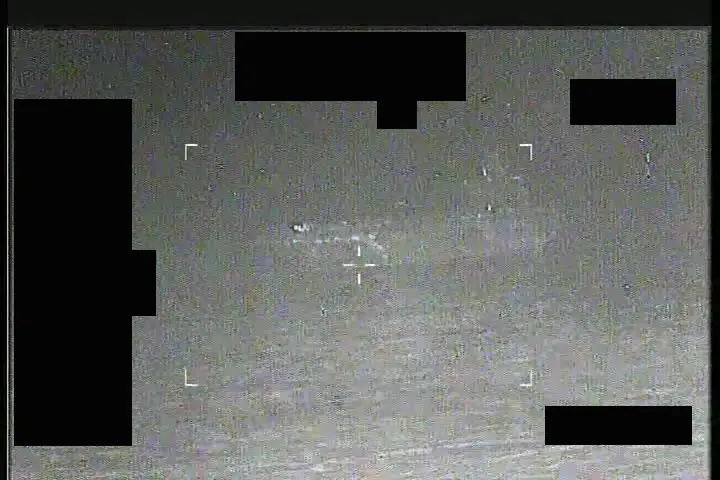 ▶ Watch the official video: Unresolved UAP Report, Middle East, 2020
The 1957 wave, AAWSAP and the rest
Most of the Air Force intelligence reports come from the October and November 1957 sighting wave, in places from Virginia, Massachusetts, Nebraska, New Mexico and Washington to Japan, Iran and Peru. Among them is the Air Force’s intelligence report on the Levelland, Texas, sightings of 2–3 November 1957 (D191), in which drivers said their engines and headlights failed near a glowing object; we looked at the Blue Book file on Levelland earlier this month. A Michigan report (D197), as the Pentagon summarizes it, describes two observers near Indian Trails on Lake Erie who saw a silver-gray, bell-shaped object on the night of 13 October 1957. Note that war.gov’s index lists one of the reports (D203) under Canada; the report itself is about a sighting at Upland, California.
The AAWSAP files continue the Bigelow and DIA records we covered in October. They include the 2008 statement of work for the contract, talking papers prepared for meetings with Senator Harry Reid, a letter from Reid, a November 2009 review of a request to make the program a special access program, and a December 2010 memo by DIA director Lt. Gen. Ronald Burgess describing the program and the 26 technical reports it had produced. The largest file in the release, D172, is the contractor’s 538-page ten-month report from July 2009.
We have written up every file in this release on its own page, and the page for each says what the file holds, read from the document itself where the scan allows. The originals are on WAR.GOV/UFO.
Sources
- U.S. Department of War: Pentagon UFO files, Release 8 (WAR.GOV/UFO), November 20, 2026 archived
- U.S. Department of War: Department of War Publishes Eighth Release of Unidentified Anomalous Phenomena Files, November 20, 2026 archived
- CIA via WAR.GOV: CIA-UAP-D027, Office of Scientific Intelligence briefing on “Flying Saucers,” 14 August 1952 archived
- U.S. Air Force via WAR.GOV: DOW-UAP-D206, Unresolved UAP Report, California, 1953 (Lockheed sighting of 16 December 1953) archived
- DVIDS: DOW-UAP-PR168, Unresolved UAP Report, Middle East, 2026 archived
- FOX 9: Pentagon releases eighth batch of declassified UFO files including a 1952 CIA flying saucer evaluation report, November 20, 2026 archived
- Interesting Engineering: US releases 1953 report on dark, elliptical UFO and CIA records in new Pentagon files, November 20, 2026 archived
- UNILAD (citing The Independent): Pentagon releases eerie footage of unknown object flying over US warship in latest UFO file dump, November 21, 2026 archived