NEWS · LAKE SUPERIOR, MICHIGAN
Kinross, 1953: what the Air Force’s released file says about the F-89 that vanished over Lake Superior
On November 23, 1953, an Air Force interceptor merged with an unknown target on radar and was never found. The accident file, released in part under FOIA, records no cause, and its own times and positions don’t agree.
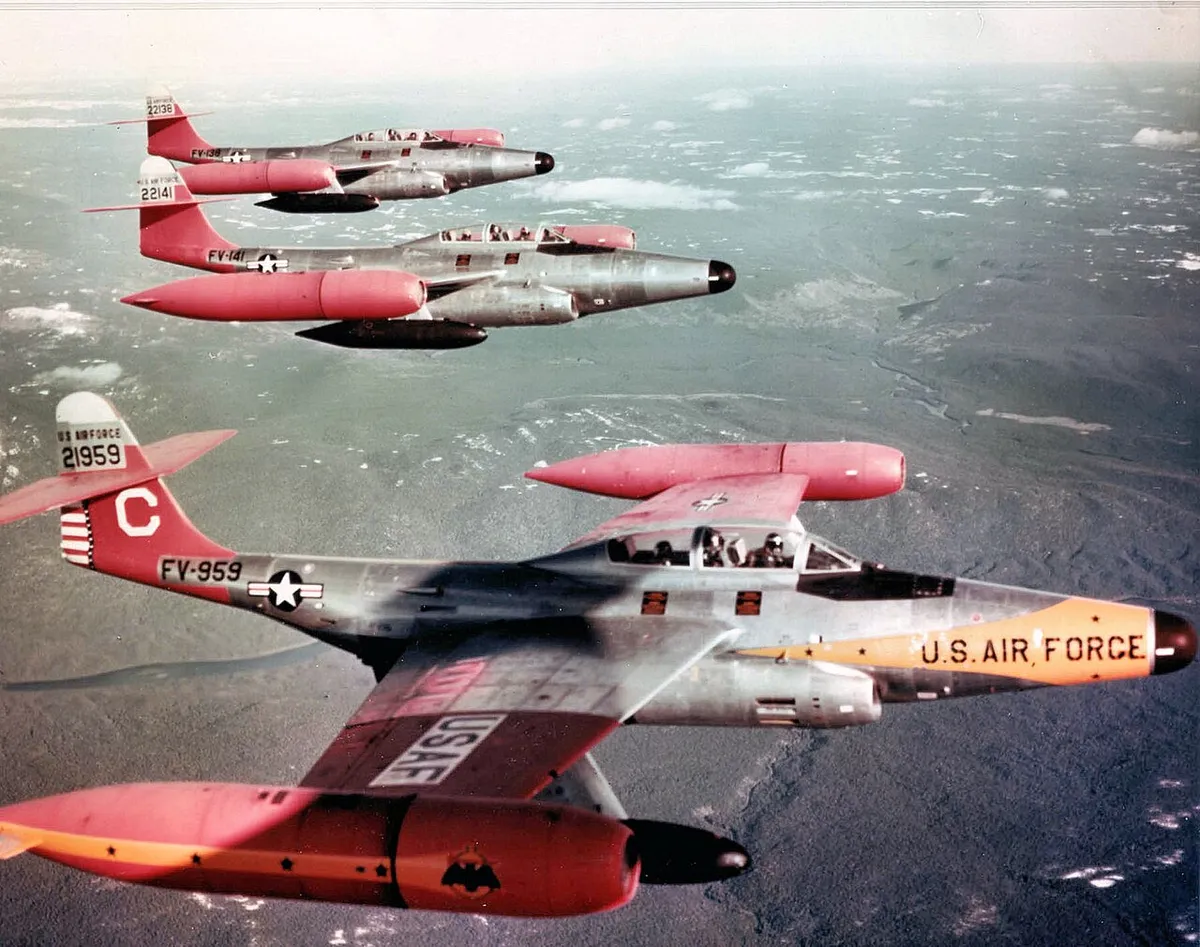
On the evening of November 23, 1953, a Northrop F-89C Scorpion interceptor took off from Kinross Air Force Base in Michigan’s Upper Peninsula to identify an unknown aircraft over Lake Superior. On a ground controller’s radar scope, the jet’s return merged with the target’s, and the jet was never seen again. Its crew, 1st Lt. Felix Moncla Jr. and 2nd Lt. Robert Wilson, were never found. UFO writers have long called it one of the classic cases, and the Air Force’s account has been disputed for decades. With the 73rd anniversary eleven days away, we read the Air Force accident file, which was released in part under the Freedom of Information Act, to see what it says and what it leaves out.
What the accident report records
The file is a transcribed copy of a FOIA release, posted by NICAP with permission of the Computer UFO Network. A cover letter from Col. John R. Clapper of the Air Force Safety Agency answers a request dated December 27, 1993 and says the pages are the “releasable portions” of the 1953 mishap report. According to the report’s summary, the aircraft belonged to the 433rd Fighter Interceptor Squadron of Truax Field, Wisconsin, and its crew was on temporary duty at Kinross.
The summary says the F-89 took off at 6:22 p.m. Eastern time, was handed from one ground-control-intercept station (call sign “Naples”) to another (“Pillow”) at 6:41 p.m., and at 6:47 p.m. descended to 7,000 feet to begin the interception, over northern Lake Superior. At 6:51 p.m. the pilot was told to turn to a heading of 20 degrees; after the turn he was told the unidentified aircraft was at his 11 o’clock, ten miles away. The summary then says the returns of both aircraft “were then seen to merge” on Pillow’s scope, and that the other aircraft’s return “was continuing on its original flight path, while the return from the F-89 disappeared.” Another section puts the merge at about 6:55 p.m. and says the jet’s identification-friend-or-foe signal vanished shortly afterward.
The report identifies the target as a Royal Canadian Air Force Dakota (C-47), serial VC-912, flying from Winnipeg to Sudbury, Ontario and crossing northern Lake Superior from west to east at 7,000 feet. The released pages do not say how the aircraft was identified. The weather, according to the file, was light snow, with ceilings as low as 500 feet and moderate to heavy icing in cloud.
What it doesn’t settle
The released pages record no cause. The part of the file written by the safety board, its analysis, findings and recommendations, is withheld under a FOIA exemption, as are witness statements. What remains is blunt: “An extensive aerial search has revealed no trace of the aircraft. The aircraft and its crew is still missing.” A separate search report, written from the Canadian side of the effort, says that because the cause of the disappearance could not be determined, the search was widened to “all possibilities.”
The search itself was large. Two USAF rescue SA-16 amphibians, a Coast Guard SA-16 and the Coast Guard vessel Woodrush searched through the first night and the following day; the RCAF later supplied four C-47s. The report totals 29,600 square miles covered, and active search was suspended on the evening of November 28. It was reopened in May 1954 after the radar observer’s father, R.O. Wilson, turned up new leads, including a report of a low-flying aircraft near Limer, Ontario, and was suspended again on May 23.
The file also contradicts itself. Contact with the jet is logged as lost at 2339 Zulu (6:39 p.m. Eastern) in the missing-aircraft message, last radio contact at 2352 Zulu in the report’s accident description, and contact lost at 6:55 p.m. Eastern in the search report; the summary says the jet was reported missing at about 8 p.m. The missing-aircraft message gives the last reported position as 45 degrees north, which lies over Lake Michigan, while the same message’s remarks, and the search report, put the loss at 48 degrees north, in Lake Superior. The summary places the jet about 150 miles northeast of Kinross as it began the interception, while the accident description puts the target about 160 miles northwest. A 1999 NICAP commentary asks whether the 45-degree figure is a typo for 47 degrees.
The vertigo explanation and the Canadian denial
The explanation most often quoted comes from outside these pages. According to History.com, an Air Force statement to the Associated Press first said the jet had been followed by radar until it merged with an object 70 miles off Keweenaw Point; the Air Force later retracted that, said the controller had misread the scope, and said Moncla was probably stricken with vertigo and crashed. History.com also reports that the Project Blue Book file attributes the loss to an accident “probably” caused by vertigo, and says the lack of wreckage was understandable given the deep water. The released accident pages we read do not mention vertigo, and the safety board’s conclusions are withheld, so we could not check what the board itself found. Wikipedia, citing the full board report, says vertigo is not listed among the board’s findings and that the vertigo leads were treated as hearsay.
The Canadian side is disputed. Wikipedia reports that Gerald Fosberg, the RCAF pilot, emphatically denied, in a 2006 documentary, the Air Force’s account that his off-course flight was the target. The NICAP commentary says Canadian officials have denied any of their aircraft was being intercepted, and that the Air Force has been silent on how it identified the Dakota; History.com says the author Donald Keyhoe reported that two Air Force representatives gave Moncla’s widow contradictory explanations. Aircraft parts found near Lake Superior’s eastern shore in 1968 were never identified publicly, according to Wikipedia, and a 2006 claim that divers found the wreck was later judged a hoax.
What the record can and can’t settle
The file confirms an intercept, a radar merge, a lost jet and a very large search, and it gives the Air Force’s identification of the target. It does not show a collision, a UFO or vertigo, and the board’s findings are not public. The ordinary explanations, an accident in winter weather or a collision with the Dakota, rest partly on the Air Force’s word, which the pilot of that aircraft is reported to have rejected. Our Mantell case page covers another pilot lost chasing an unidentified target, and our Levelland article reads another Blue Book file.
Sources
- NICAP / Computer UFO Network: Kinross AFB missing F-89C, 23 Nov 1953, USAF Report of Aircraft Accident (FOIA release, transcribed) archived
- NICAP / Computer UFO Network: Kinross AFB missing F-89C, commentary, July 3, 1999 archived
- History.com: Darryn King, This Air Force Jet Was Scrambled to Intercept a UFO—Then Disappeared, January 7, 2020 (updated February 18, 2025) archived
- Wikipedia: Felix Moncla archived