The Mantell Crash
- On January 7, 1948, the Kentucky Highway Patrol reports a strange aircraft near Maysville, and staff in the tower at Godman Army Airfield say they see a large, white or silver object.
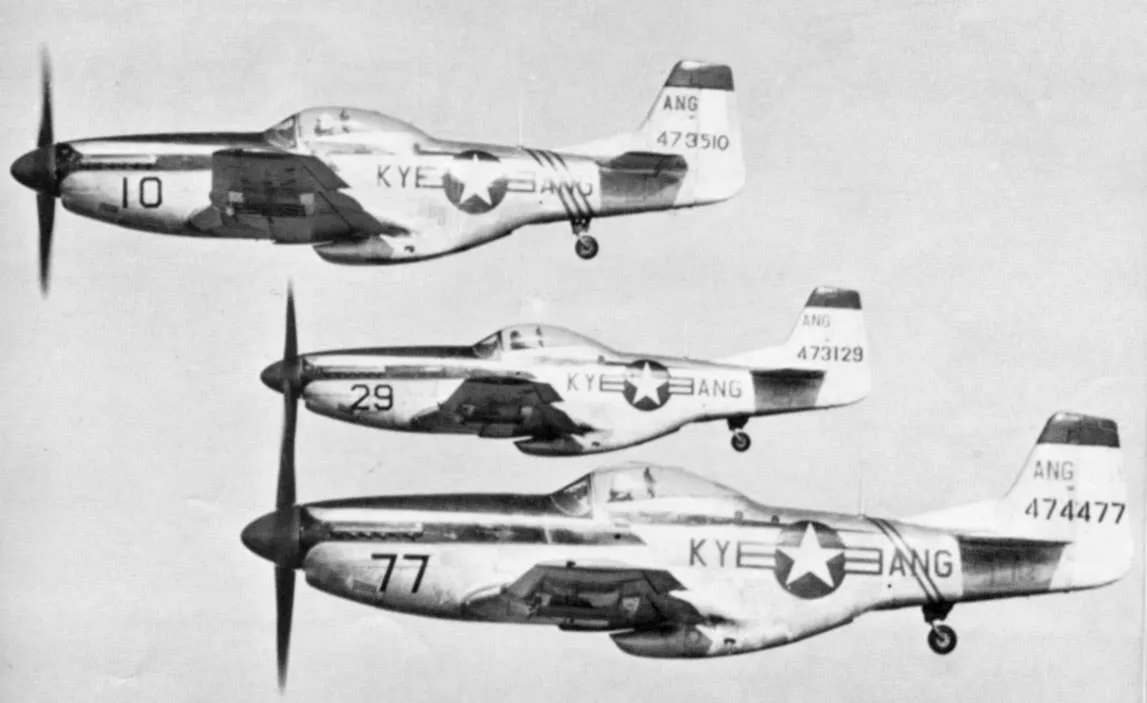
- Capt. Thomas Mantell leads two wingmen in F-51 Mustangs after it and keeps climbing as they turn back. His fighter crashes on a farm near Franklin, Kentucky, and he is killed.
- The accident report, as summarized years later by Ruppelt, found he blacked out from lack of oxygen. Project Sign first blames Venus, but Project Blue Book chief Edward Ruppelt later concludes that the object could have been a Skyhook balloon.
- No launch record for a balloon that day has been found, so the identification is unproven. A wingman later said the bright object he saw looked like a star.
Key witnesses: Godman Field tower staff and officers, Lt. A. W. Clements and Lt. B. A. Hammond (wingmen), Col. Hix (base commander), callers in Maysville, Owensboro and Irvington
Status: PARTIALLY EXPLAINED
Background
Captain Thomas F. Mantell Jr., 25, was a Kentucky Air National Guard pilot from Franklin, Kentucky, who had flown transport aircraft in the Second World War and earned the Distinguished Flying Cross. In January 1948 he led a flight in the 165th Fighter Squadron, which flew North American F-51D Mustangs. A profile on This Day in Aviation lists 2,167 total flying hours for him, only 67 of them in the F-51.
The case also touches a Cold War secret. Beginning in 1947 the U.S. Navy launched enormous high-altitude research balloons under the name Skyhook. In February 1951 Office of Naval Research physicist Urner Liddel publicly argued that the balloons explained saucer reports, telling reporters that low sunlight on their undersides could make them look like saucers.
What was reported
According to Edward Ruppelt’s account, the Kentucky Highway Patrol phoned the control tower at Godman Army Airfield, on the Fort Knox reservation, at about 1:15 p.m. on January 7 about an unusual aircraft near Maysville. Some twenty minutes later came reports from Owensboro and Irvington of a ‘circular’ object ‘about 250 to 300 feet in diameter’ moving west at a ‘pretty good clip’. Tower staff and officers watched it through binoculars. Ruppelt lists their descriptions as including ‘a parachute’, ‘an ice cream cone tipped with red’ and ‘huge and silver or metallic’.
Four F-51s were asked to look. One, low on fuel, turned home, and Mantell climbed with his two remaining wingmen, Lt. A. W. Clements and Lt. B. A. Hammond. In Ruppelt’s version Mantell radioed, ‘I see something above and ahead of me and I’m still climbing’. Later retellings have him calling the object metallic and ‘tremendous in size’, but Ruppelt wrote that no one in the tower could recall his exact words. Hammond told the Louisville Courier-Journal he felt ‘a little shaky’ at 15,000 feet and was seeing double by 22,000, and the wingmen turned back.
Mantell kept climbing alone. His Mustang came down on a farm about five miles southwest of Franklin, roughly 90 miles from Godman, and his wristwatch had reportedly stopped at 3:18 p.m.
Investigations and official findings
As Ruppelt summarized the accident report he obtained in 1952 (the report itself was not available for this article), the F-51 lost a wing from excessive speed in a dive after Mantell blacked out for lack of oxygen. According to This Day in Aviation, a medical examiner gave the cause of death as ‘dislocation of the brain’. Ruppelt wrote that the body was not burned or riddled with holes and the wreckage was neither radioactive nor magnetized, despite rumors to the contrary.
The Air Force’s first UFO project, Project Sign, soon told the press that Mantell had chased the planet Venus. Astronomer J. Allen Hynek’s later calculations, as Ruppelt reported them, put Venus about 33 degrees above the horizon against the tower’s estimate of roughly 45, and only about six times brighter than the surrounding sky, so faint that he doubted it was the target. An internal Sign routing sheet from autumn 1948 states that other evidence ‘conclusively proves that this object was not the planet Venus’. Ruppelt dismissed the official 1949 report as ‘weasel wording’.
Reviewing the file in 1952, Ruppelt concluded that a Skyhook balloon, possibly launched from Clinton County Air Force Base in Ohio, was a plausible match. He used wind data to reconstruct a possible path but could not find launch records for that day, and he presented the answer as unproven.
Explanations and debate
The balloon theory rests partly on same-day accounts. Ruppelt noted that a caller in Madisonville, Kentucky, and an astronomer near Nashville each reported seeing a balloon through a telescope, and the Courier-Journal two days after the crash described an object near Nashville identified as a balloon trailing a rope. Ruppelt described the Skyhook project as highly classified at the time and wrote that Mantell had never heard of such a balloon, let alone seen one. The accident finding, meanwhile, accounts for his death without any unusual cause.
Doubters of the balloon note that no launch record has surfaced for January 7. Supporters of a more unusual reading point to the tower’s descriptions of a large, defined shape, and to the Sign sheet rejecting Venus. Clements, however, told the Courier-Journal that the bright object he saw looked like a star and that he later became convinced it was a star or other celestial body. Ruppelt also passed on a long-time friend’s remark that Mantell was a cautious flyer who would not have ignored oxygen unless he was chasing something that mattered to him. Rumors that his body was full of bullets or that the wreck was radioactive have no supporting evidence, according to Curtis Peebles as summarized by Wikipedia, and Ruppelt wrote that the accident report found the wreck was not radioactive.
Why it still matters
Military.com calls Mantell the first Air Force pilot to die chasing a UFO, and the case remains one of the best-known early examples of a sighting with a fatal ending. The Venus answer satisfied newspapers for more than a year even though Hynek later calculated that Venus was too faint to pick out that afternoon, and if Ruppelt’s balloon answer is right, the episode is an early example of a classified balloon program producing reports that officials could not discuss. A historical marker in Franklin was unveiled on September 29, 2001, near the Interstate 65 exit, and Mantell is buried at Zachary Taylor National Cemetery in Louisville.
Sources
- Ruppelt: The Report on Unidentified Flying Objects, ch. 3 (Project Gutenberg) archived
- Wikipedia: Mantell UFO incident archived
- Military.com: The First Air Force Pilot to Die Chasing a UFO Was Actually Chasing a Secret Balloon, October 31, 2022 archived
- This Day in Aviation (Bryan R. Swopes): Thomas Francis Mantell Jr. archived
- Louisville Courier-Journal, January 9, 1948: Chase for Flying Disk Blamed in Crash Death (NICAP transcript) archived
- Project Sign routing sheet on the Godman sightings, 1948 (NICAP) archived
- The Evening Telegraph (AP), February 13, 1951: If You Saw ’em You Were Right, They Were Saucers (NICAP reprint) archived