The Tehran Incident
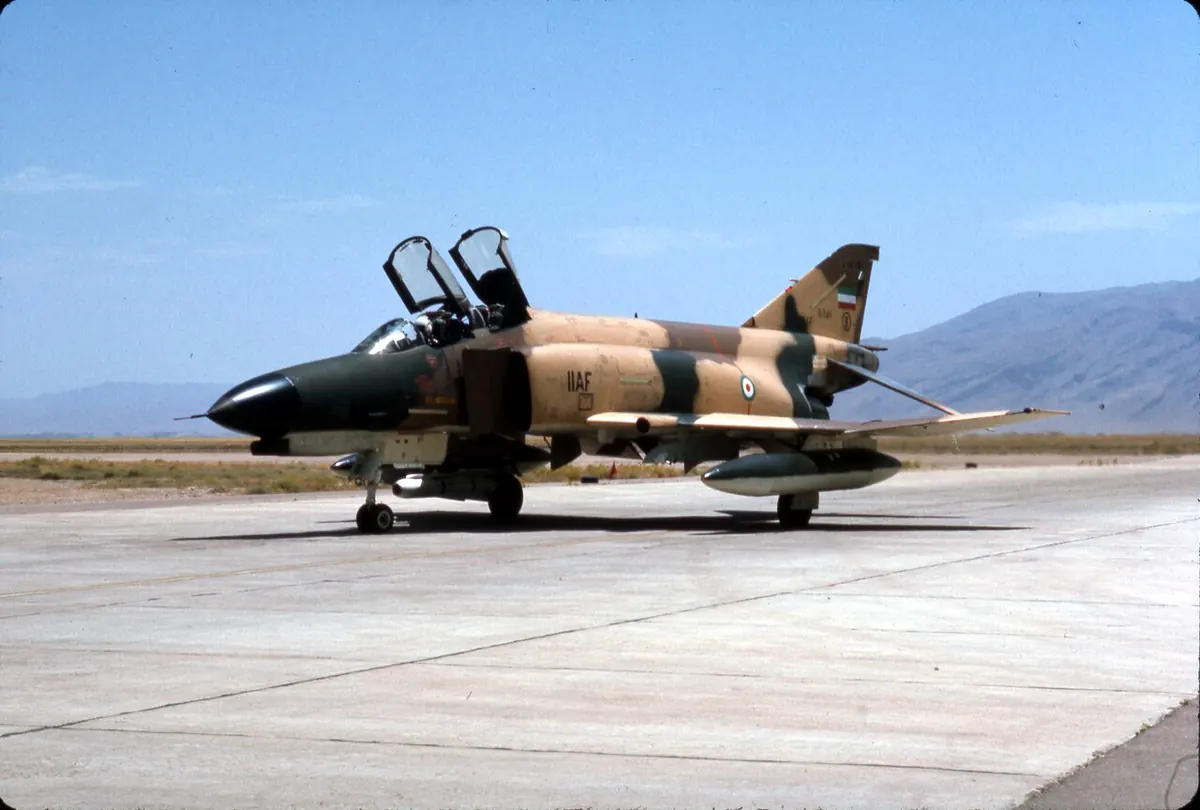
- Residents report a bright object over Tehran shortly after midnight on September 19, 1976.
- An Imperial Iranian Air Force F-4 is scrambled; as it closes in, its instruments and communications fail. They return when it turns away.
- A second F-4 reports a smaller object separating from the main one. The pilot attempts to fire a missile — and his weapons panel goes dead.
- A U.S. Defense Intelligence Agency report circulated to the White House and NSA describes the case as meeting ‘all the criteria’ for valid study.
Key witnesses: Maj. Parviz Jafari, Iranian air traffic control
Status: UNRESOLVED
Background
In 1976 Iran was ruled by the Shah and was one of the closest U.S. allies in the Middle East. The Imperial Iranian Air Force flew American-built F-4 Phantom II fighters, and U.S. military advisers and contractor technicians from companies such as McDonnell Douglas and Westinghouse worked at Iranian bases. A U.S. Air Force section chief in Tehran, Lt. Col. Olin Mooy, was invited to the Iranian debriefing that followed the events of September 19, and his memorandum became the main American record of them.
Little Iranian documentation is publicly available, partly because of the 1979 revolution. Most of what is known comes from U.S. cables and later interviews with the Iranian participants.
What was reported
Around 12:30 a.m., the air force command post received calls from residents of the Shemiran district about a bright light in the sky. A general officer, identified in later accounts as Gen. Nader Yousefi, went outside, saw a light he judged larger and brighter than a star, and ordered an F-4 scrambled from Shahrokhi Air Base near Hamadan. Its pilot, Lt. Yaddi Nazeri, reported seeing the light from about 70 miles away, then losing his instruments and radio at roughly 25 nautical miles, until he broke off and turned for home.
A second F-4, flown by Parviz Jafari with weapons officer Jalal Damirian, launched about ten minutes later. The crew reported a radar lock at 27 nautical miles with a return comparable to a KC-135 tanker, and lights flashing blue, green, red and orange. As they followed it south of Tehran, a smaller bright object appeared to come toward them; Jafari said he tried to fire an AIM-9 missile but his weapons panel and radios failed, and he dove away. The crew also reported a light that seemed to descend to the ground. A helicopter search the next day found no wreckage, though searchers picked up a beeper signal near a house whose occupants reported a loud noise and a flash.
Investigations and official findings
A U.S. cable summarizing the events, probably drafted by the defense attaché’s office, reached the Joint Chiefs of Staff the same day, and it was distributed to the White House, the Secretary of State, the CIA, the NSA and senior military commands. A Defense Intelligence Agency evaluation, attributed to analyst Roland Evans, called it ‘an outstanding report’ and a classic meeting ‘all the criteria necessary for a valid study of the UFO phenomenon.’ The cable was released under the Freedom of Information Act in 1977. A dramatized retelling by Capt. Henry S. Shields, ‘Now You See It, Now You Don’t,’ ran in an Air Force newsletter on electronic interference in 1978. No U.S. agency has published a conclusion about what the crews saw.
Explanations and debate
Skeptic Philip Klass, who interviewed American technicians who had worked at Shahrokhi, reported in UFOs: The Public Deceived (1983) that only one of the two F-4s had electrical failures and that this jet had a history of intermittent faults. A McDonnell Douglas supervisor suggested the radar might have been in a manual tracking mode, producing a misleading lock. Klass and James Oberg proposed that the first bright light was the planet Jupiter, and Brian Dunning of Skeptoid noted that several meteor showers were active that night. Mooy’s memo itself suggested the beeper may have come from a C-141 transport.
Proponents argue that the combination of ground witnesses, radar contact, equipment failures on more than one aircraft and a senior U.S. intelligence assessment sets the case apart. Jafari, who later retired as a general, spoke at a Washington press conference organized by journalist Leslie Kean and filmmaker James Fox in November 2007. He wrote that the object was ‘flashing with intense red, green, orange and blue lights so bright that I was not able to see its body.’
Why it still matters
The Tehran cable is one of the most frequently cited government documents in UFO literature, largely because of the DIA evaluator’s unusually positive wording. It has featured in Kean’s 2010 book, in television documentaries and in The New Yorker’s 2021 account of how the Pentagon came to take the subject seriously.
Sources
- Wikipedia: 1976 Tehran UFO incident archived
- The Black Vault: DIA report on the Tehran incident archived
- Skeptoid: The Tehran UFO Incident, 2012 archived
- The Black Vault: The 1976 Iran incident case file archived
- The New Yorker: How the Pentagon started taking U.F.O.s seriously, 2021 archived
- AVweb: Pilots want UFOs investigated, 2007 archived
- U.S. Air Force: Now You See It, Now You Don’t (Shields, MIJI Quarterly), 1978 (archived NSA release)