The Socorro Landing
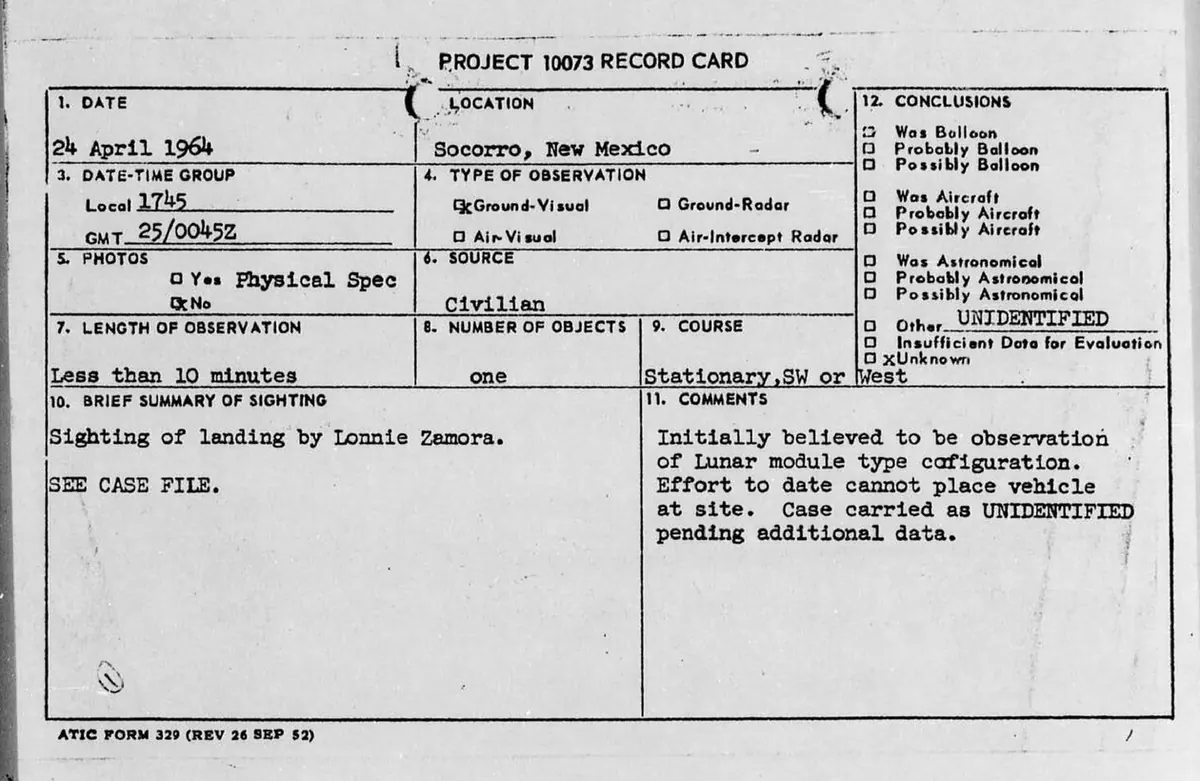
- Around 5:45 p.m. on April 24, 1964, police Sgt. Lonnie Zamora is chasing a speeding car when he hears a roar and sees a flame in the sky. He breaks off the chase to investigate.
- He reports finding a shiny, egg-shaped object in a gully, with two figures in white coveralls standing beside it. Moments later, he says, it lifts off with a roar and a blue-orange flame.
- Officers, including State Police Sgt. Sam Chavez, find smoldering brush and four shallow holes where Zamora says the craft’s legs touched down. Air Force consultant J. Allen Hynek visits and calls Zamora’s account solid, not a hoax.
- Project Blue Book lists the case as ‘unknown’. Skeptics suggest a student prank (a theory backed by former New Mexico Tech president Stirling Colgate) or a secret lunar-lander test.
Key witnesses: Sgt. Lonnie Zamora (Socorro Police); Sgt. Sam Chavez (NM State Police) examined the site
Status: UNRESOLVED
Background
In 1964 Socorro was a small town in the Rio Grande valley, home to the New Mexico Institute of Mining and Technology and not far from the military test ranges of southern New Mexico. Lonnie Zamora had reportedly worked in the college’s machine shop before joining the police. An FBI agent who had known him for about five years described him in a May 1964 memo as ‘well regarded as a sober, industrious, and conscientious officer and not given to fantasy.’
At the time Project Blue Book was headed by Hector Quintanilla Jr., the Air Force officer who would later describe the case for the CIA’s in-house journal, Studies in Intelligence, in 1966.
What was reported
According to the statement Quintanilla published, Zamora turned off his chase because a dynamite shack stood in the direction of the flame and he feared it had exploded. He needed three tries to get his car up a loose gravel hill. From the top he saw a shiny object in an arroyo, roughly 150 to 200 yards away, and at first took it for an overturned car. He said he also saw two people in white coveralls standing beside it. He radioed that he was checking a wreck, got out, and then heard a loud roar that started low and rose in pitch.
Fearing an explosion, Zamora ran, bumped his leg on the car and lost his glasses. When he looked back, he said, the object had risen to about the height of the car. After the roar stopped he heard a brief whine, followed by silence. He said the object then flew off low to the southwest, cleared the dynamite shack by about three feet and disappeared over a mountain. He radioed the dispatcher that ‘it looks like a balloon’. In his written account he said the two figures might have been ‘small adults or large kids.’ The local newspaper, El Defensor Chieftain, later reported that an unidentified tourist had stopped at a gas station and mentioned a low-flying craft.
Investigations and official findings
An Army officer from White Sands Missile Range and FBI agent D. Arthur Byrnes Jr. reached the site that evening. According to the FBI file, Byrnes noted four indentations in the ground, then left the inquiry to the Air Force. Blue Book sent investigators, and its scientific consultant, J. Allen Hynek, visited Socorro within days.
Quintanilla’s 1966 article lists the checks his team made. They included Geiger counter readings, the balloon control center at Holloman Air Force Base, weather balloon releases, helicopter flights across the state, the White House Command Post and companies doing lunar-vehicle research. Soil samples showed no foreign material, radiation was normal, and the burned brush held no chemicals that could be identified as propellant. He noted that the Holloman radar closest to Socorro had shut down for the day at 4 p.m. He called it ‘the best-documented case on record’, said his team could not find the vehicle or other cause, and said the findings gave no sign of an extraterrestrial origin. Blue Book filed the case as unidentified.
Explanations and debate
No prosaic explanation has been confirmed. A White Sands range log for that day lists a helicopter-borne test of a Surveyor lunar lander, but it was scheduled for the morning, and the skeptic Brian Dunning has noted that the test area lay far from Socorro. The aviation writer Philip Klass, who visited in 1966, argued that local figures staged a hoax to attract tourists. Others have proposed a manned hot-air balloon.
The student-prank theory gained ground in 2009, when researcher Anthony Bragalia publicized a handwritten note found in the papers of chemist Linus Pauling. In it, New Mexico Tech president Stirling Colgate answered Pauling’s question about the sighting: ‘I have a good indication of the student who engineered the hoax. Student has left.’ No participant has ever been publicly named, and skeptics themselves concede that how such a prank was carried out has not been explained. Supporters of the case point to Zamora’s consistency, the physical traces and the difficulty of keeping a hoax secret for decades. The balloon scientist Charles B. Moore, who later visited the site, believed Zamora sincerely saw something strange.
Why it still matters
Socorro became the model of a credible close-encounter report: a sober officer, traces on the ground, and an official file that never closed it. Hynek and the French researcher Jacques Vallée counted it among the best cases ever recorded, and it stayed on Blue Book’s list of unknowns until the project closed in 1969. Zamora, who died in 2009, rarely discussed the sighting in later life, and the arroyo south of town still draws visitors.
Sources
- Socorro County Historical Society: The Socorro UFO (PDF) archived
- CIA Studies in Intelligence: Quintanilla, The Investigation of UFO’s, 1966 archived
- The Black Vault: FBI files on the Socorro landing (FOIA release) archived
- Skeptical Inquirer: Famous Socorro ‘UFO Landing’ a Student Prank?, 2010 (PDF) archived
- Skeptical Inquirer: A Different Angle on the Socorro UFO of 1964, 2001 (PDF) archived
- Skeptoid: Lonnie Zamora and the Socorro UFO, 2017 archived