Rendlesham Forest
- Late December 1980, security patrols near RAF Woodbridge investigate lights in the forest, believing an aircraft has crashed.
- Staff Sgt. Jim Penniston says he approached and touched a small triangular craft covered in symbols.
- Two nights later, Lt. Col. Charles Halt leads a team into the forest, recording real-time audio of lights and beams, and later reports elevated radiation readings.
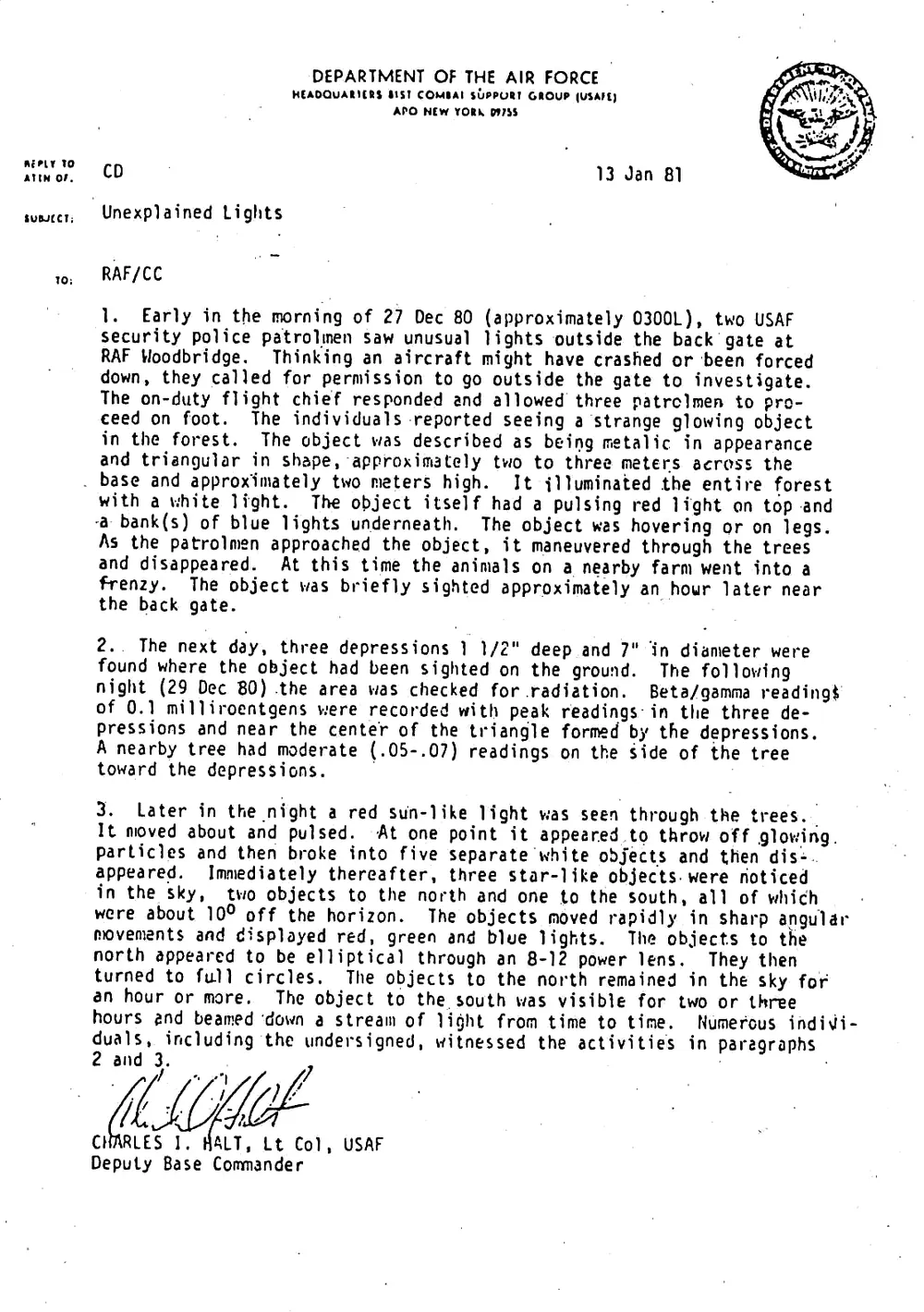
- The ‘Halt memo’ is sent to the UK Ministry of Defence and released under the U.S. Freedom of Information Act in 1983.
Key witnesses: Lt. Col. Charles Halt, Staff Sgt. Jim Penniston, Airman John Burroughs
Status: UNRESOLVED
Background
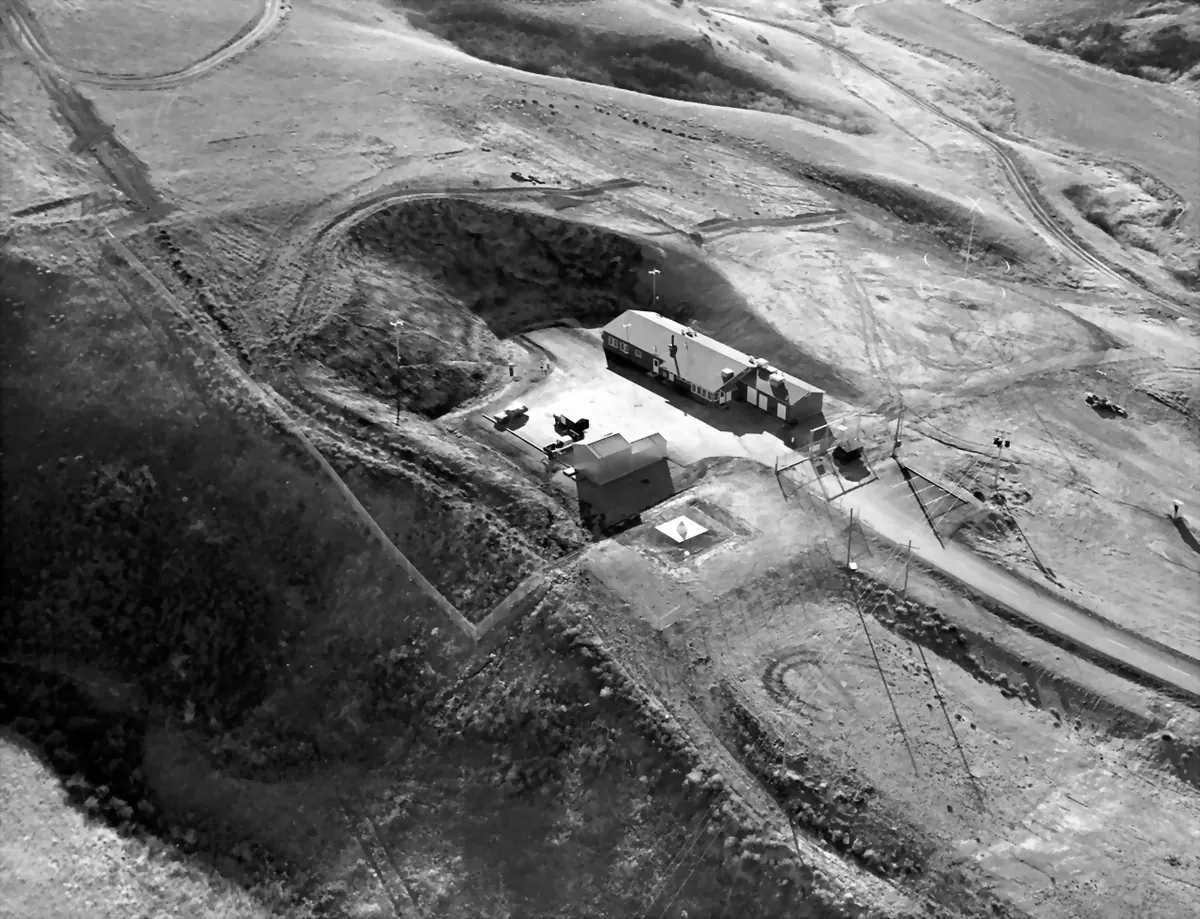
In 1980 the neighboring air bases of RAF Bentwaters and RAF Woodbridge, near the Suffolk coast, were Royal Air Force stations in name but were operated by the U.S. Air Force. Rendlesham Forest, a managed pine plantation, runs up to Woodbridge’s East Gate. Several miles beyond its eastern edge stood the Orford Ness lighthouse, whose beam figures in nearly every later account.
Col. Ted Conrad was the base commander, with Lt. Col. Charles Halt as his deputy, under wing commander Col. Gordon Williams. The first night’s patrol consisted of three security policemen: Staff Sgt. Jim Penniston, Airman John Burroughs and Airman Edward Cabansag.
What was reported
At around 3 a.m. on December 26, 1980, personnel at Woodbridge saw lights that appeared to come down into the trees east of the base. Thinking an aircraft might have crashed, the three patrolmen went out through the East Gate and followed a flashing light through the forest. The base law enforcement desk telephoned Suffolk police at 4:11 a.m. Two officers came out, searched the area and found nothing; according to their log, the only light they could see was the Orford lighthouse. After daybreak the airmen found three shallow depressions in a clearing and marks on nearby trees. A police officer who was called back that morning recorded the marks but noted that they ‘could have been made by an animal’.
Late on December 27, after word that the lights had returned, Halt went into the forest with a small team, a radiation meter and a pocket tape recorder. His memo to the Ministry of Defence, dated January 13, 1981 and titled ‘Unexplained Lights’, describes the first night’s object as metallic and triangular, roughly two to three meters across the base, and reports beta/gamma readings of 0.1 milliroentgens with peaks in the depressions. It goes on to describe a red, sun-like light moving through the trees and several star-like objects in the sky, one of which seemed to beam light down toward the ground. The memo gives the wrong dates for both nights.
Investigations and official findings
The British government’s reaction was low-key. According to the MoD official then running its UFO desk, Halt’s memo arrived no earlier than January 14, 1981. Files released by the National Archives in 2009 show that the ministry could not explain the lights but judged them to be of ‘no defence significance’, because air defense radar had detected nothing unidentified. Later correspondence confirmed that none of the witnesses was ever interviewed. A briefing written for defense minister Lord Trefgarne argued that the two-week delay before the memo was sent, and the low-key way Halt handled the matter, showed how little defense importance the incident deserved. Lord Hill-Norton, a former Chief of Defence Staff, disagreed, warning ministers that the case was ‘a potential banana skin’. Defence Secretary Michael Heseltine replied to another correspondent that there was ‘not a grain of truth’ in claims of a cover-up. A further release in March 2011 revealed that defense intelligence UFO files covering 1980 to 1982 had been destroyed. Researcher David Clarke called this routine disposal of largely duplicate files.
Explanations and debate
Astronomer and journalist Ian Ridpath began investigating as soon as the story broke in the News of the World in October 1983, prompted in part by local forester Vince Thurkettle’s suggestion that the flashing light was the lighthouse. Ridpath argues that the first sighting coincided with an exceptionally bright fireball over southern England, that the airmen then followed the lighthouse beam, that the ground marks were rabbit diggings and the tree cuts were made by foresters, and that Halt’s radiation readings were at background levels. He links the star-like lights on Halt’s tape to bright stars, the brightest of them in the direction of Sirius.
Supporters of the case point to the number of trained military witnesses over two nights, and a memo and a tape made at the time. Halt has said that he could see the lighthouse separately, well to one side of the light he was watching; Ridpath says his photographs show the lighthouse in line with a farmhouse, the same direction in which Halt, in a 1997 interview, placed the light. Penniston’s later claims have drawn objections even from fellow witnesses. Burroughs told Ridpath in 2006 that ‘Penniston was not keeping a notebook as it went down’, and Halt wrote in 2019 that when he handled the notebook in 2003 there was ‘No code or missing pages.’
Why it still matters
Rendlesham has never gone away. In a notarized affidavit in June 2010, Halt stated his belief that the objects were extraterrestrial and accused U.S. and British security services of trying to obscure what happened. Conrad, his former commander, rejected the allegation, saying of Halt: ‘He knows better.’ Penniston said in 2010 that his notebook contained pages of binary code received telepathically, and in 2014 he and Burroughs published Encounter in Rendlesham Forest with former MoD official Nick Pope. Burroughs has spent years seeking his military medical records and recognition of heart problems he links to the event. Whether read as a cover-up or as misidentified lights, it remains Britain’s most argued-over UFO case.
Sources
- Wikipedia: Rendlesham Forest incident archived
- The Halt memorandum (Wikimedia Commons) archived
- The National Archives: UFO files release, August 2009 (PDF) archived
- Dr David Clarke: Rendlesham Forest UFOs archived
- Dr David Clarke: UFO files break records, 2011 archived
- Ian Ridpath: The Rendlesham Forest UFO case archived
- Ian Ridpath: Jim Penniston’s notebook archived
- Ian Ridpath: Col Halt’s affidavit, 2010 archived