The Trent Photos
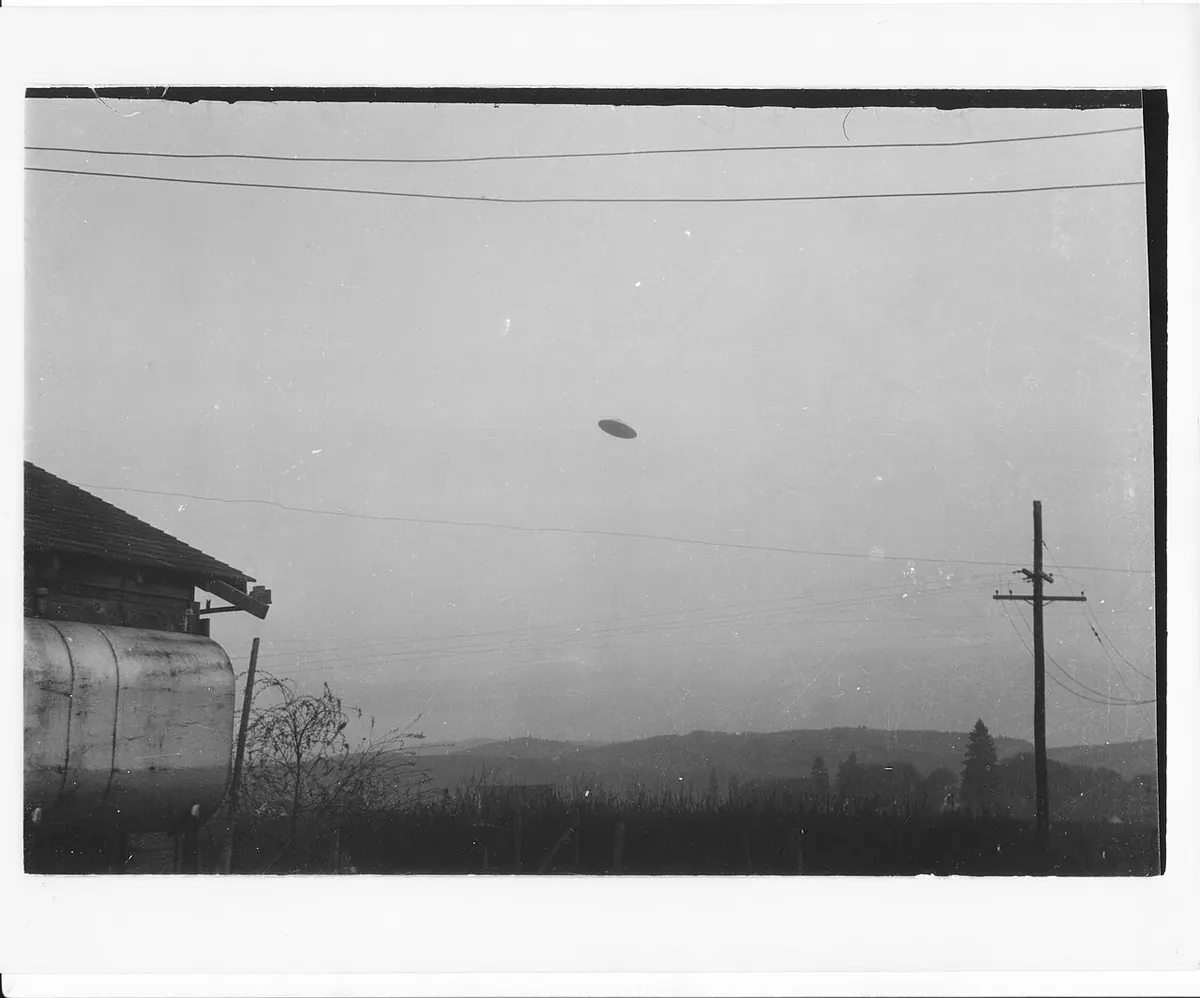
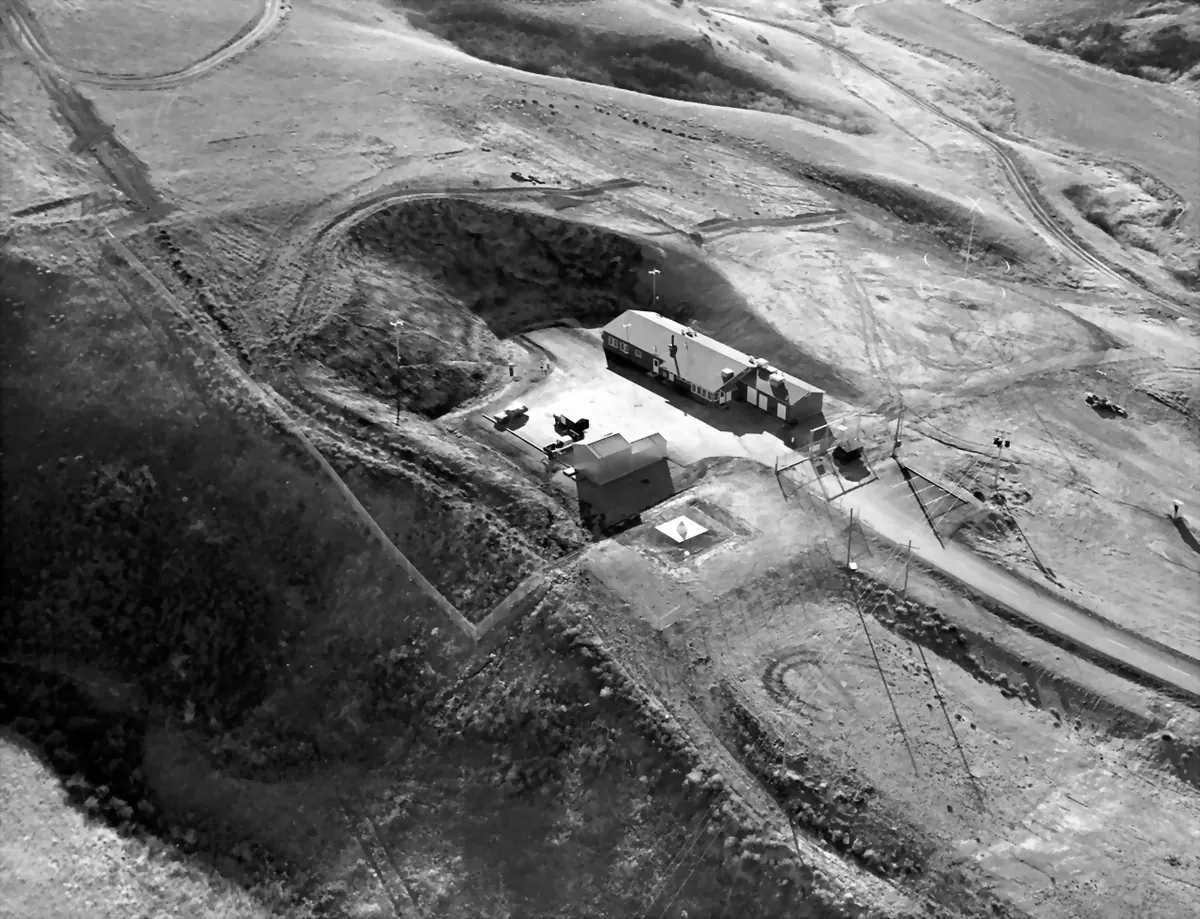
- On the evening of May 11, 1950, farmer Evelyn Trent says she sees a slow, metallic, disc-shaped object gliding toward her farm near McMinnville.
- Her husband Paul grabs the family camera and takes two photos before, the couple says, the object speeds off to the west. The pictures run in the local paper and then in Life magazine.
- The Air Force-funded Condon study later calls it ‘one of the few UFO reports’ where everything examined appears ‘consistent with’ a real, artificial flying disc. It adds that the evidence cannot ‘positively rule out a fabrication’.
- Skeptics argue that shadows show the photos were taken in the morning, not the evening, and that the object sits right under an overhead wire, which fits a small model hung on a thread. The Trents never profited from the photos and stood by their story until they died.
Key witnesses: Evelyn Trent, Paul Trent (photographer), Paul’s father (reportedly, briefly)
Status: DEBATED
Background
Paul and Evelyn Trent farmed a small property between McMinnville and Sheridan in Oregon’s Yamhill County, keeping chickens and rabbits. The family owned a simple folding roll-film camera, a Universal Roamer, which was already partly loaded when the sighting took place.
The Trents later said that their first instinct was to keep quiet, partly because they assumed the object might be a secret military craft and did not want to get into trouble. The pictures only came to light weeks later, after the rest of the roll had been used up and the film developed.
What was reported
According to the couple, Evelyn was finishing the evening chores at around 7:30 or 7:45 p.m. on May 11 when she saw the object to the northeast, moving slowly westward. She called Paul, who fetched the camera, took one picture, wound on the film and took a second from a few feet away, within about thirty seconds. After the second shot, they said, the object picked up speed and disappeared to the west.
A friend, Frank Wortman, encouraged Paul to show the prints to the press. Bill Powell, a reporter for the McMinnville Telephone-Register, visited the farm and, according to the Condon report, found the negatives ‘on the floor under a davenport’, where the Trent children had been playing with them. The paper ran both photos on its front page on June 8, 1950. Within days they were in newspapers in Portland and Los Angeles, and Life magazine published them later that month. The Trents traveled to New York to appear on the television program We the People, and national reporters briefly nicknamed the town ‘Saucerville’.
Investigations and official findings
There is no record of a detailed military investigation in 1950. The serious examination came in 1967, when astronomer William K. Hartmann, then working for the Air Force-funded University of Colorado UFO study led by physicist Edward Condon, located the original negatives, which had passed from the International News Photo Service to United Press International. He visited the farm, compared the photos with the surrounding landmarks and measured how much haze lightened the object compared with nearby features.
Hartmann estimated that the object was roughly a kilometer away and therefore large, and he wrote that all the factors he had examined appeared consistent with the witnesses’ claim that an ‘evidently artificial’ disc tens of meters across had flown past, while adding that the evidence did not ‘positively rule out a fabrication’. He also tested whether a small model hanging from the overhead wires in the photos could produce the same result, and found he could not rule it out. His report, published in 1969, left the case among the small group the study could not explain.
Explanations and debate
Skeptics have focused on the lighting. Investigator Robert Sheaffer, who first studied the photos in 1969, argues that the shadows on the garage show the pictures were taken in the morning, not the evening as the Trents said, and he cites Weather Bureau records reporting no clouds that evening to reflect light onto the scene. He has also promoted a stereoscopic analysis suggesting the object is small and close and did not move between the two frames. Others have suggested a model, a trash-can lid or a vehicle side mirror; researcher Joel Carpenter proposed a mirror from an old truck. In 2013 and 2014 a French group, IPACO, published an image analysis arguing that the object was small, close to the camera and probably hanging from a thread.
Defenders, led by optical physicist Bruce Maccabee, who studied the negatives in detail from the 1970s, argued that the haze measurements point to a large, distant object and that the shadows can be explained by light scattered from bright clouds near the setting sun. Supporters also stress that the Trents never sought money, repeated a consistent account for nearly half a century and, by family accounts, maintained until their deaths in the 1990s that they had photographed something real.
Why it still matters
The two pictures are among the most reproduced UFO images ever taken, and they are often used as a test case for photo analysis methods. The negatives themselves became the subject of a dispute: Maccabee borrowed them in the 1970s and in 2001 sent them back to the News-Register, the successor to the original paper, which then kept them despite requests from the Trents’ daughters. McMinnville now holds an annual UFO festival each May, built around the photographs that put the town on the map.
Sources
- Condon Report, Case 46 archived
- Wikipedia: McMinnville UFO photographs archived
- Offbeat Oregon History (Finn J.D. John): Fierce debate over McMinnville UFO sighting continues today, 2018 archived
- KVAL / KATU News: Fight over UFO photos pits family versus newspaper, 2008 archived
- Robert Sheaffer, The Debunker’s Domain: The Trent UFO Photos, revised 2014 archived
- KOIN 6 News: Oregon’s extraterrestrial history — the 1950 Trent UFO sighting