The Flatwoods Monster
- At about 7:15 p.m. on September 12, 1952, boys playing football in Flatwoods say they saw a fiery object cross the sky and apparently land on a nearby farm hill. They fetched beautician Kathleen May and climbed the hill with a flashlight.
- At the top the group reported a pulsing red light and, in the flashlight beam, a tall figure with a round red ‘face’ inside a pointed, hood-like shape. It hissed and glided toward them, and they fled, some later reporting nausea and sore throats.
- The next morning a local editor reported skid marks and a gummy deposit. Writer Gray Barker and Ivan Sanderson investigated; Donald Keyhoe reported that Air Force investigators concluded the light was a meteor and the creature probably an owl.
- In a 2000 investigation Joe Nickell argued for a meteor, aircraft beacons, tracks left by a local man’s pickup and a startled barn owl. Researcher Stanton Friedman disputed it, and the Air Force’s reported meteor-and-owl conclusion rests on secondhand accounts.
Key witnesses: Kathleen May (beautician), Eddie and Fred May, Neil Nunley, Eugene Lemon (17), Tommy Hyer, Ronnie Shaver; A. Lee Stewart Jr. (Braxton Democrat editor); Gray Barker and Ivan T. Sanderson (investigators)
Status: EXPLAINED / DISPUTED
Background
Flatwoods is a small community in the hills of Braxton County, in central West Virginia. On the evening of Friday, September 12, 1952, at about 7:15 p.m., several local boys were playing football on the school playground when, by the account that has come down through Gray Barker’s writing, they saw something fiery cross the sky and apparently come down on a hilltop belonging to the Bailey Fisher farm.
The story spread quickly through local papers and radio. Barker, a West Virginia writer on UFO subjects, arrived about a week afterward and wrote it up for Fate magazine, drawing on tape-recorded interviews. The paranormal writer Ivan T. Sanderson also visited, and Major Donald Keyhoe, an early UFO author, later reported on it as well.
What was reported
The boys ran to the home of Kathleen May, a local beautician. She took a flashlight and led the group up the hill: her sons Eddie and Fred, Neil Nunley, Eugene Lemon (17), Tommy Hyer and Ronnie Shaver, along with Lemon’s dog. Ahead of them they reported a pulsing red light, which some described as a ball or globe. Lemon said he then saw a pair of shining, animal-like eyes and aimed the flashlight at them.
According to the accounts, the beam showed a towering, man-like figure with a round, red ‘face’ inside a pointed, hood-like shape. Its body looked dark to most, though some later said green, and Mrs. May described drape-like folds. Barker’s account put it at about ten feet tall; other tellings range from seven to nearly twelve feet. The witnesses said it hissed and glided toward them. Lemon screamed and dropped the flashlight, and everyone ran.
The group also reported a pungent mist or metallic smell. Some, especially Lemon, were later said to be nauseated and to have irritated throats. The sheriff and a deputy, who came from checking an unrelated report of a downed airplane, searched the hill that night and reportedly found nothing. At about 7 a.m. the next day, A. Lee Stewart Jr., editor of the Braxton Democrat, reported two parallel skid marks in the grass and an ‘odd, gummy deposit’.
Investigations and official findings
The sources opened for this entry do not include a primary Air Force case record. Keyhoe’s 1953 book, Flying Saucers from Outer Space, as summarized by Joe Nickell, said Air Force intelligence reportedly sent two men in civilian clothes, posing as magazine writers, who judged the light a meteor that only appeared to land, that the boys’ illness was an effect of fright, and that the ‘monster’ was probably a large owl on a limb with underbrush below it. Keyhoe also reported that several astronomers called the object a meteor. A HISTORY article says West Virginia state police dismissed the reports as hysteria, noting that the creature’s reported height had grown from seven to seventeen feet in a day.
Keyhoe’s account is a secondhand, 1953 retelling; the investigators were not named, and the primary Air Force record was not located for this entry.
Explanations and debate
Nickell, a skeptical investigator, visited Flatwoods on June 1, 2000. He interviewed local residents including Johnny Lockard and his son Max, and quoted a former local editor (Byrne 1966) saying a meteor was visible in at least three states that night, Maryland, Pennsylvania and West Virginia. He cited a report that a Maryland science academy staff member said a meteor passed over Baltimore around 7 p.m. He noted that a local teacher mentioned a nearby plane beacon at the time, that Sanderson himself conceded three beacons were ‘in sight all the time on the hilltop’, and argued one could account for the pulsing red light. Max Lockard told him he drove his 1942 Chevrolet pickup across the field that evening, and Nickell concluded that it left the skid marks and deposit, though Barker had doubted that. Nickell said the mist was easily explained as ordinary fog, citing Keyhoe, and relayed the Air Force view that the illness was an effect of fright, while noting that the illness story ‘may be overstated’.
For the creature, Nickell proposed a startled barn owl. He matched the round, hooded ‘face’, the hiss, the gliding motion and the small clawed ‘hands’ to the bird, and noted that the witnesses glimpsed the figure for only seconds. He did not think the witnesses lied; Mrs. May and her son Fred declined to speak with him. Skeptoid’s 2014 episode reached similar conclusions, attributing the symptoms to hysteria and exertion.
Critics reject this. The UFO researcher Stanton Friedman wrote in 2002 that Nickell ‘did not talk to the witnesses’ and did not visit the hillside, the tree or the flat area at the top, and said a ten-foot owl and a meteor landing without a loud explosive sound would be remarkable. Nickell’s own article describes a site visit (Max Lockard took him to the spot) and interviews with local residents such as the Lockards, but not with the principal eyewitnesses, since Mrs. May and her son Fred declined. The accounts therefore conflict on whether he visited the site, and Friedman’s ‘witnesses’ may refer to the group on the hill. Friedman instead wrote that ‘it seems clear the object was in trouble when it landed’. Mrs. May later reportedly called what she saw a secret government plane, according to Nickell.
Why it still matters
Nickell opened his article by calling Flatwoods a paranormal ‘cold case’ that had never been fully explained, before arguing for the barn owl; the sources disagree on whether his solution closes it. The sighting is one of the most widely retold close-encounter stories of the early 1950s, and it shows how a mix of a real meteor, ambiguous lights, fear and a brief look at an unfamiliar shape can produce competing accounts that investigators are still weighing.
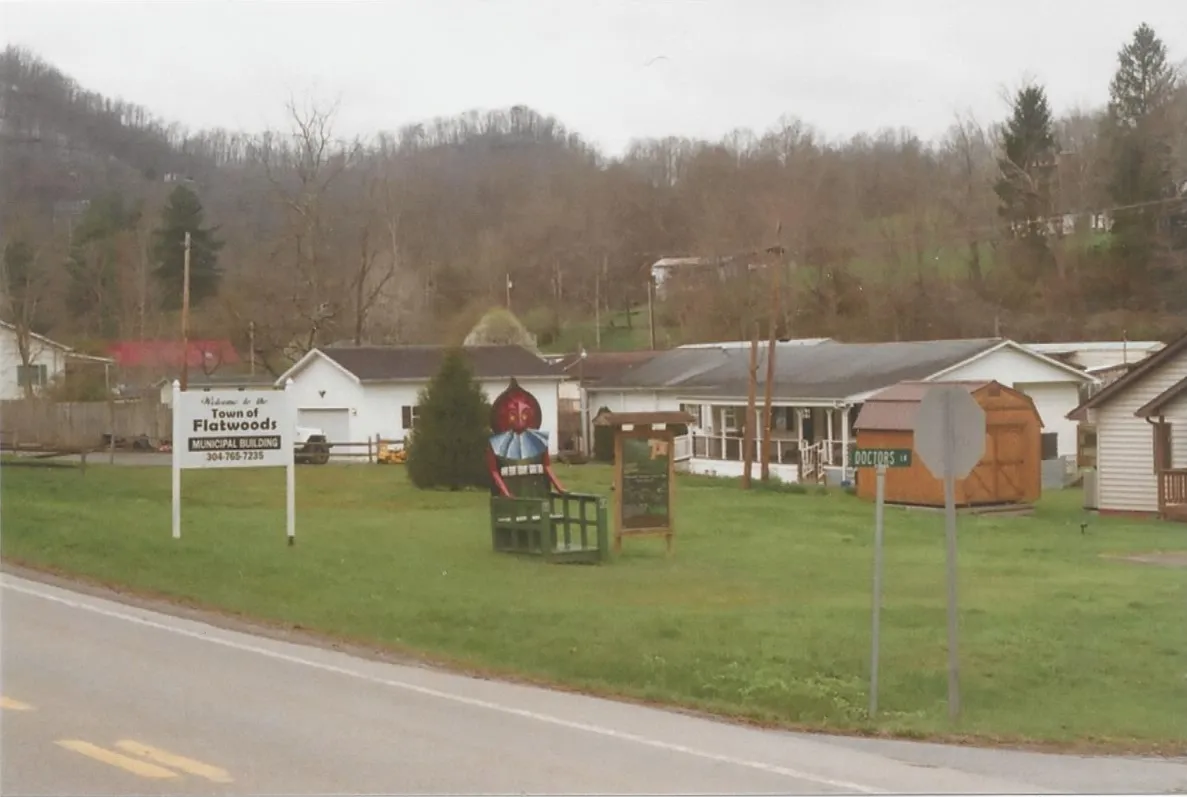
The town has embraced the legend. A sign seen by Nickell in 2000 greeted visitors with ‘Home of the Green Monster’, a festival marked the 50th anniversary in 2002, and a museum in nearby Sutton and an annual convention keep the story alive.
Sources
- Joe Nickell, Skeptical Inquirer: The Flatwoods UFO Monster, November/December 2000 archived
- Skeptoid: The Braxton County Monster, September 30, 2014 archived
- HISTORY: In 1952, the Flatwoods Monster Terrified 6 Kids, a Mom, a Dog—and the Nation, July 20, 2018 archived
- e-WV: Flatwoods Monster (Buddy Griffin), revised February 8, 2024 archived
- The Black Vault: Stanton T. Friedman, Flatwoods Monster UFO Event, December 15, 2002
- Wikipedia: Flatwoods monster archived